
Celebrating Women in Credit: A Q&A with Industry Leaders
As published in The Secured Lender – March 2026, Vol. 82, Issue 2, Page 86-90
BY MICHELE OCEJO
In this insightful Q&A, we feature three remarkable women credit professionals who have made significant strides in their careers. Betty Hernandez, executive vice president/chief credit officer at SLR Business Credit; Mignon Winston, vice president/underwriting team leader at Great Rock Capital, and Hailee Ledford, vice president of client relations at AmeriFactors, share their experiences, challenges, and successes.
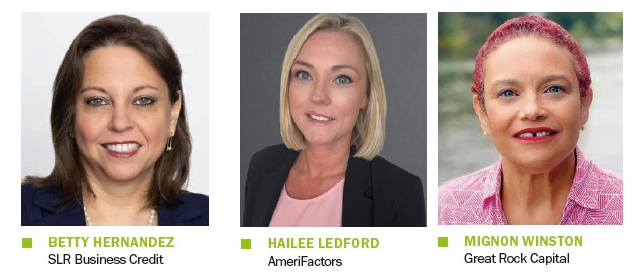
Betty Hernandez Executive Vice President/Chief Credit Officer SLR Business Credit
Tell us about your career trajectory.
After graduating from Rutgers University, I started my career in a credit training program in New Jersey at First Fidelity Bank, a mid-sized regional bank. After nine months of classroom training, I was rotated through various departments to support lenders as an underwriter. There I was exposed to many different types of lending facilities and borrowers including non-profits, wholesalers, distributors, real estate and leasing. In July 1990, at the end of the two-year program, I was placed in the bank’s asset-based lending department. This department was headed by Ted Kompa, with Jeff Goldrich, Dan Tortoriello and Mike Coiley as team leaders. My role was account executive, but before I was given accounts to handle, Ted wanted me to get field exam experience. I was sent out with various field examiners under the tutelage of Ira Wolfe, the audit manager. I audited staffing companies as well as manufacturers and distributors prior to becoming an account executive.
In 1995, Ted and Jeff had an opportunity to leave First Fidelity (which was soon to become First Union and now Wells Fargo) to start up an independent finance company called Business Alliance Capital Corp. (BACC). I vividly remember Jeff’s farewell speech, as he had just turned 40 and I was about to have my second child. He discussed turning 40, leaving a stable bank job to start up a new independent finance company with no borrowers day one. I, too, had no idea what the future would hold as everything had been changing so rapidly.
After working briefly at PNC Business Credit, I re-joined my former colleagues at BACC as an underwriter. In 2005 BACC was sold to Sovereign Bank (later to become Santander Bank). Eventually Santander decided to exit the BACC portfolio, and I became a team leader in their workout department working for Tony Cortese and later Mike Maiorino. In 2010 Jeff and Dan had successfully raised equity and had obtained a leverage facility to re-start on their own again. I joined them, and a few others, to co-found North Mill Capital LLC and serve as the firm’s chief credit officer.
In 2017, we were acquired by SLR Investment Corp. (Nasdaq: SLRC). We were later re-branded to SLR Business Credit, and thanks to the support provided by our parent company, we’ve been able to grow our portfolio exponentially. In 2010, when we started, we had 16 loans with $19 million outstanding. Today, as a result of six acquisitions and organic growth, we have over 150 borrowers and $1 billion in credit facilities under management. I am responsible for credit quality and the performance of the portfolio. I oversee all new fundings. I enjoy meeting with customers face to face and touring their facilities. I really enjoy the team and culture we have built. I am very fortunate to have been working with my mentors and friends for over 35 years.
Can you share a specific moment when you had to make a difficult credit or portfolio decision? How did you balance risk, instinct, and accountability in that call?
Each and every day, we are making credit and portfolio decisions and asking “Should I approve this advance today” It’s an easy decision if the borrower is “in formula” and there are no “red flags,” i.e. the collateral is performing well, the company’s collateral and financial reporting is adhering to the requirements outlined in our loan agreement, the field examinations have been “clean.” However, it is more complicated when a borrower is tight on availability and is asking for just “a little more.” For example, they could ask for a temporary reprieve of the cross-aging or other ineligible rules that we have agreed to. It always seems like those are the days that the borrower needs money for payroll or to pay a critical vendor. It is in those moments that I ask myself, “How am I going to get back into formula if I make this advance?” Is the borrower’s response plausible? For example, can “more sales” or “collections of a specific account debtor payment” be achieved? I also ask: “For how long is this request going to be needed?”, “Is this a permanent situation where if I ‘bend this rule’ we will never be able to go back to the originally intended structure or is it truly temporary?”, “Do we have additional collateral or a block in availability that is effectively covering this request?”, and “Is this a constant request (and red flag)?” All these questions are contemplated and evaluated when making those tough daily decisions to lend.
Tell us about a challenging client situation. What was at stake, and how did you navigate the relationship while protecting your institution?
In my first portfolio management role, I underwrote and managed a borrower with 100% receivable concentration: a government contractor selling exclusively to the U.S. Department of Defense. As a growing company, the borrower really should have been working with an ABL lender. However, the bank’s senior management strongly wanted the transaction and approved a cash flow line of credit that required an annual 30-day clean-up and monthly reporting. This loan structure was the lending equivalent of putting a size 10 foot into a size 8 shoe!
Prior to closing the loan, I spoke with the company’s contract officer at the DoD, who referred to the company as “one of our stars.” Over and above the monthly reporting, I kept in constant contact with the CEO about the status of existing and potential new contracts, shipments, and receivable collections. I regularly reminded him of the requirement to repay the loan in full for 30 consecutive days to comply with the lending arrangement, which was challenging given that it was a growing, non-seasonal business. Senior management at the Bank was pleased and relieved when the company successfully completed its 30-day clean-up requirement.
Lessons learned: Independent of the reporting cadence, maintain consistent contact with your borrower as to the status of the underlying business and its implications for near-term liquidity and borrowing needs. Don’t rely solely on the loan documents to stipulate the lending requirements: engage directly with the borrower’s management about upcoming deal requirements and how the company intends to comply. Be in an anticipatory mode, not a reactive mode.
Looking back on a tough deal or client outcome, what did the experience change about how you approach underwriting, portfolio monitoring, or leadership today?
Lessons learned over the years on tough deals:
1. Asset based lenders focus a lot on collateral and may not focus sufficiently on the caliber of borrower management. The ability of borrower management to source/produce widgets and sell them at the right price to the right customers and collect the ensuing A/R is what gives the business its viability and the collateral its value. Borrower management should be assessed as strong, satisfactory, or weak.
2. If the borrower’s CFO resigns, call them directly and ask them if there is anything going on at the company that the lender should be aware of.
3. Overcommunication is always preferable to inadequate communication, both within your firm and with a borrower.
4. It is imperative to perform borrower site visits on a regular basis.
5. Independent of your firm’s performance review cadence, it is important to give team members ongoing feedback, both positive and constructive, so they can perform optimally in their role and meet your expectations going forward.
To view the rest of this article: TSL0326_CelebratingWomenInCredit
To view the March 2026 issue of The Secured Lender, please visit https://issuu.com/thesecuredlender